Nina Cole
November 18, 2013
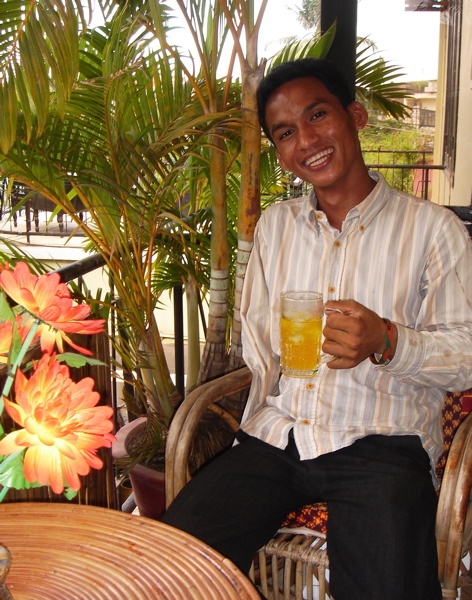
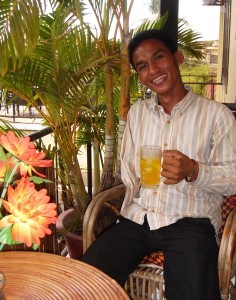
Last evening I spent two and a half hours with Da over dinner. He has got to be the sweetest young man in the world. There is a purity of spirit and mind about him that is not like anyone else I know. It is unexpected because he has not had an easy life, being from a dirt poor rural family with a missing father, having lost the bottom of his right arm in a land mine accident, and spending several of his early years living with other land mine kids at the land mine museum.
Despite the fact that it is water festival weekend (a big holiday here) and despite invitations from friends to go to water festival parties, he had spent the day (Sunday) finishing work for his boss and then traveling for six hours to come and see me.
Da explained to me that just prior to the water festival, the bus ticket prices go up, and that they revert to regular prices once the festival starts. So he was surprised when he was charged the higher price during the festival, and pursued a discussion with the ticket seller about the reason for this change. Da said that he would not previously had this discussion but that he had studied economics and the concepts of supply and demand, so he was compelled to challenge this new pricing policy. I said “Yes Da because you are educated.”
Da graduated from university in December 2012 with a degree in agriculture and rural development. He was one of the top four or five students in a class of about 100. His thesis involved surveying farmers in different villages on some question and analyzing this data. His experience with survey data gathering and analysis is in short supply in Cambodia and this is very advantageous for him.
Since graduation, he has had a series of contract jobs with NGOs in Phnom Penh. Several NGOs have called him recently to offer him this sort of work, but since he already has a contract, he refers them to other new grads that he knows. It would never occur to Da to try to get the NGO to defer the work so that he could get the job.
He still lives in the room he had as a student. Although he does not like PP, he understands that the opportunities needed to give him a good start at his career are located there.
He understands the importance of a good CV showing as much diverse experience as possible. Unlike some of his fellow graduates, he does not refuse to take jobs that offer low pay, because he would never imagine anything else but starting at the bottom and working his way up. He is incapable of believing that he should get any special advantages for any reason.
One NGO had him documenting deforestation and he went high up a hill to look at an even larger hill that he had played on as a kid. Most of the trees on the large hill had been cut down, and he said tears fell out of his eyes. He was shocked that the forestry company had cut down most of the trees on the hillsides but had left the bottom part.
I explained to him that all over the world forestry companies do this to make it difficult for anyone to see how much has been cut. Being jungle raised, he understands that plants and animals will lose their habitat as a result.
When he got back to the village where he was staying, he needed to be close to nature and wanted to go and sleep in the jungle, but no one would go with him! I’m sure he slept many nights in the jungle as a kid.
But mostly the NGOs use him to gather information from farmers across the country. The info is needed for their program design and their reports to head offices around the world.
He loves being in the countryside and loves dealing with farmers. And the farmers love him.
His other initiative is to grow one hectare of red rice on his brother’s farmland. Red rice is nutritionally superior to white rice because it contains vitamin A. It is almost harvest time and he is concerned that his brother will not take proper care when harvesting! Da’s studies have taught him that certain harvesting procedures are important but his brother does not understand. So Da may try to travel to the farmland despite having his regular job. Red rice sells at a premium over white rice and he has found three customers in PP to sell the rice to. I asked how much the seeds cost and he said that many farmers wanted to give them to him for free but that he insists on paying a small amount for them.
So although he didn’t study business, he is instinctively maximizing his revenue and minimizing his costs.
He is learning about workplace politics and relationships and already has a mentor of sorts, a more senior NGO employee who is giving him advice. He recounted how his phone had rung one time showing a strange number and he had thought it was a friend playing a joke and he almost said “Who is this and what do you think you are doing!” However he didn’t and it turned out to be an NGO with an unusual phone number wanting him to come in for an interview. He laughed and laughed at how funny this was. Then he went to the interview and they didn’t give him many specifics about the job.
Only after he started work did he realize that it was a very hard job that took him a few weeks to figure out. He said he might not have taken the job if he known what it actually required. He thought this was very funny too.
After all his travels around the countryside in many provinces in Cambodia, Da now sees Cambodia as quite a small country. So I encouraged him to travel.
Thailand is all he is interested in seeing at the moment because it is not too far away. A passport costs $150 (actually $125 plus $25 corruption money) so he will save up for this.
I asked Da if he had a girlfriend and he said he is too busy working. So then I asked if there was anyone that he might like to have as a girlfriend if he had time. He said he liked a girl from his village who is now a secondary school teacher. She is very shy and he is not sure how to talk to her. I suggested he ask her about her students and what she liked and disliked about teaching. He went to primary school with her before he left to go and live at the land mine museum. But he said it was important to get his career going well first before he got married because he would need enough income to support his family.
I pointed out that his wife could contribute to the family income as well but might take time out or stop completely if they had children.
I asked him if he wanted children and he said yes, but only two.
He understands that despite the tradition of large families in Cambodia, it is more responsible to stop with replacing yourselves as parents.
I said that young people on Cambodia were changing a lot and becoming more like young people in other countries. So I said “Take your time Da and get married whenever you are ready.” If he and the teacher get married, they will be part of the nascent middle class in Cambodia.
It was getting late and Da still wanted to get to his village to check on his red rice early the next morning before returning to PP. He had made friends on the bus with a guy who was going to Vietnam and could give him a ride to his village, but the guy was not answering his phone so I gave Da the $5 he needed to get a moto ride instead.
What an incredible two and a half hours…. I did not provide Da with any of the wisdom he displayed on so many fronts, so he has somehow figured these things out for himself using his own intelligence as developed through higher education and considerable life experience.
Over the past few years I have seen how his university education has contributed to this maturation process. It is hard to only have such fleeting encounters with Da. But he is well on his way to life as an important citizen for the future of Cambodian society and I am exiting from my small role in his life.
I am so thankful to my friend Roy for arranging me to be the university sponsor for this incredibly pure and beautiful young man with so much potential, and such an infectious smile.
Continue reading