A Visit to the Landmine Museum
- November 29th, 2013
- Rotary District 7070 Cambodia 2013
- Sweat Equity Teams
Shirley Johnson
![photo[1]](https://makeanimpact.ca/wp-content/uploads/2013/11/photo11.jpg)
The picture of the team on a visit to the Land Mine Museum shows Aki Ra, its
founder, in the middle. As a small child, during the Khmer Rouge period,
Aki Ra was forced to be a soldier and he was taught how to lay land mines. As an
adult he realized what damage that had done to his people. Lives and limbs had been
destroyed and it had set the country back, productively and culturally. He decided
to repair the damage by taking unexploded land mines out of the ground and
neutralizing them. Then he set up a museum to show what damage war can do. Behind it
he established a school/orphanage for children of land mine victims and the poor
affected by war.
Personally Aki Ra has neutralized over 50,000 land mines, by hand, sometimes using a
stick and a pair of pliers. He says that he can remove up to 36 a day. A few years
ago he was one of the top 10 nominees on the CNN “Heroes” program for his
contribution to his countrymen and for bringing attention to the damage so many
countries have caused with these deadly weapons. He may have caused destruction in
his youth but today he is a true hero.
We know about land mines in theory but once one sets foot in this country the sense
of the damage and devastation become very real and one feels the pain. It is an
emotional experience, which hurts the heart. I wrote the following poem to bring
the message to those who may never see it for themselves. It is not a case of them
and us. We are all “we” in this imperfect world.
Cambodia’s Landmines
I walked one day where it’s now safe to walk
And silent stood because I could not talk.
My heart just broke with awe and shock and pain
Seeing the ugly objects built to kill and maim.
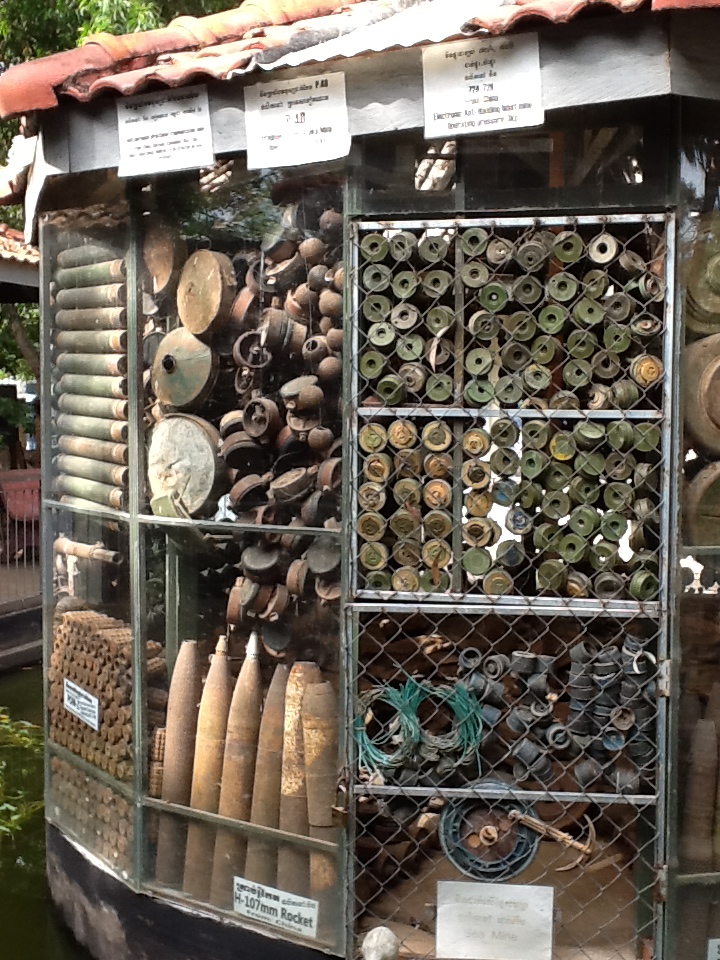
Landmines displayed in every shape and form,
Cold metal, ugly, jagged, twisted, torn,
Piled high in glassed in cases there to show
The lengths to which the evil in men’s minds can go
I walked that day where it’s now safe to be
Where landmine orphans now can safely play
I see them missing legs and eyes and arms
But happy, laughing in the bright sun’s warmth
The man who planted death when he was young
Is caring for them, trying to right the wrong.
Daily he searches fields and farms to find those mines
And neutralizes every one he finds.
I walked one day where it’s now safe to roam
Among the huts which victims call their homes.
With missing limbs they struggle on with life
And yet I see no sign of anger or of strife
These gentle people who have suffered so
Are strong and proud and try to stand alone
Missing their limbs and those they love, who died,
I stood on ground now safely cleared and cried.
I walk today upon my country’s own safe ground
And contemplate life’s lessons that I found
Among the smiling, friendly, not so foreign faces
Who carry character and dignity with other graces
And skills they want to share with us. Can we not share
The blessings that we have? They need to know we care
We don’t hand out cold funds but partner with them to effect
The changes they would choose, ’til they can stand alone, erect.